
#07: Evolution | $EVO
The toll road behind online gambling


Evolution AB
SE: Nasdaq Stockholm
Industry: Online Gambling
Market cap: $14,000 MM
The global leader in live casino and creator of the game-show category
An aggregation network operating as a toll road, where scale drives utilization and operating leverage
Outlines
A perfect storm of bad news has pushed a high-quality business down to 11x earnings
The issues are real, the question is whether they are temporary or structural
The basics remain intact: market, share, price and margin
AI does not break live casino: synthetic dealers miss its core appeal, and more games do not mean more hits
Recently announced a record €2bn buyback (~16% of shares outstanding)
Cheap is never an accident
I won’t spend long on why Evolution is a great business, because almost nobody disputes it and plenty of write-ups have already made the case (here, here and here, for example). The short version: Evolution builds and runs the live-dealer casino games that sit inside other people’s online casinos, the bet365s and FanDuels of the world. A real presenter, in a real studio, streamed to your screen, dealing blackjack or hosting a game show; Evolution runs the software and earns mainly a percentage of the operator’s gaming win. The operator owns the customer. Evolution owns the content.
The strength of that model shows up in Evolution’s financials. The company operates at a 66% EBITDA margin, earns a return on invested capital above 25%, carries net cash, and has compounded revenue at nearly 30% a year over the past five years. Very few listed businesses have economics like these.
And it’s cheap. Genuinely, unarguably cheap. At around SEK 690 a share, Evolution trades at roughly 11x forward earnings, less than half the ~25x the market paid for it, on average, over the past decade. For a business with these margins, that is the kind of multiple you put on a company in decline.
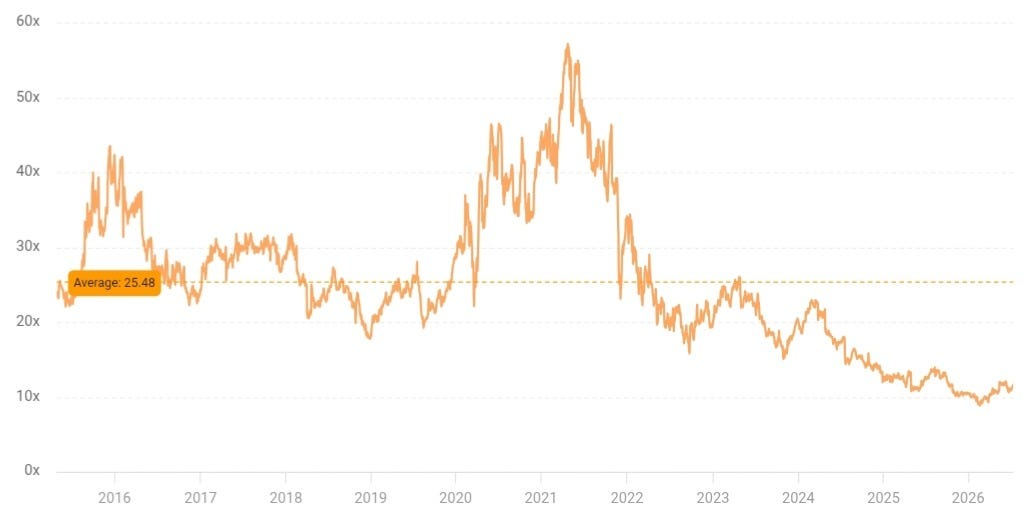
Cheap stocks are cheap for a reason, and Evolution’s reason is not one bad headline. It’s a wall of them:
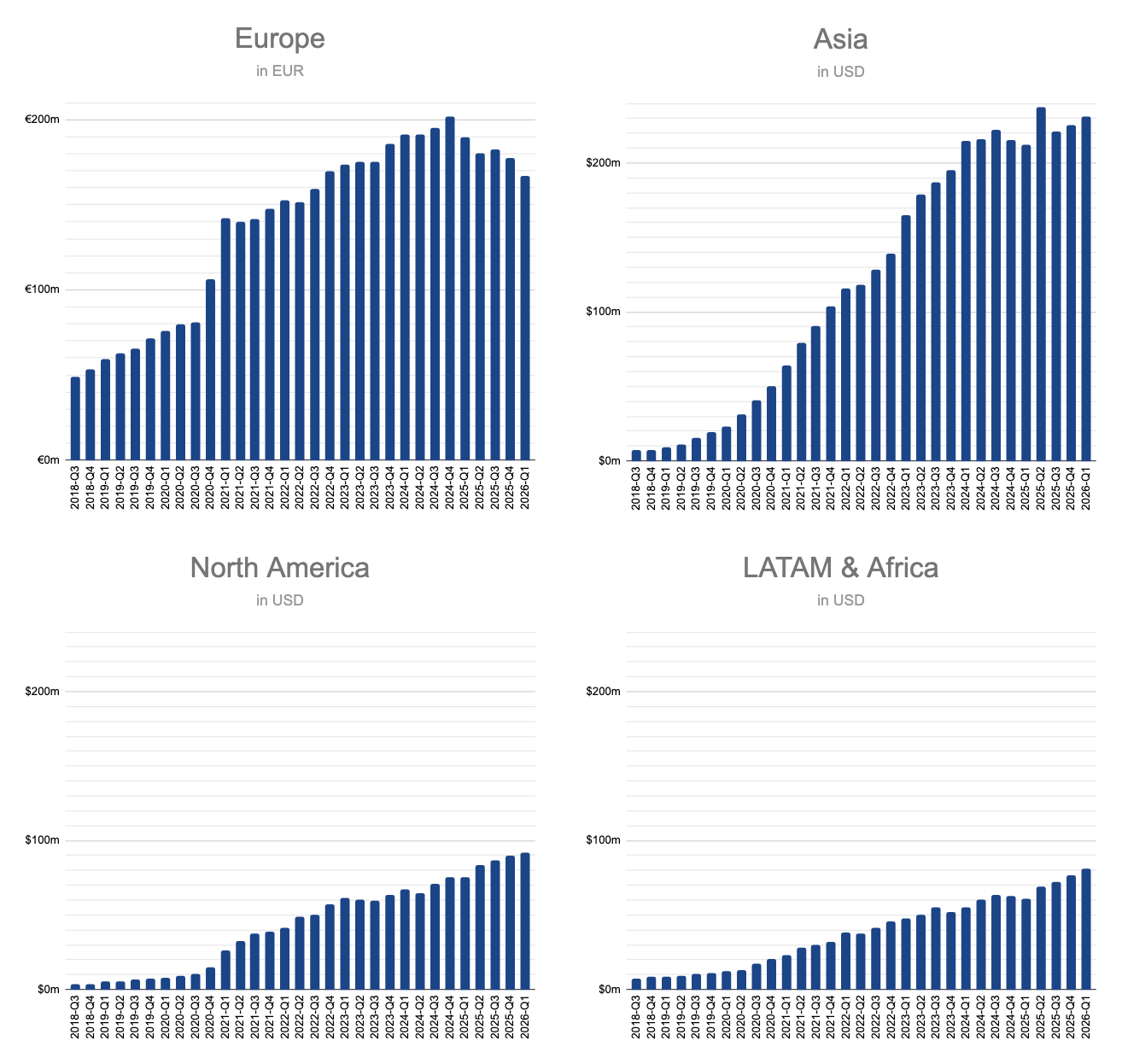
Europe. After the UK regulator opened a review of Evolution’s licence because its games could be accessed through unlicensed websites, the company responded by ring-fencing its content across Europe. The decision protects its licences, but in markets where much of the gambling still takes place through unlicensed operators, it also means giving up revenue before players move to regulated sites. European revenue has fallen, and the UK review
remains open. (it finally closed this week with a £4.75m settlement, roughly 0.5% of last year’s profit)1Asia. Cyber-criminals intercept Evolution’s live video feeds and re-stream them on illegal sites, a Pirate Bay for live casino. Asia was the growth engine; that growth stalled.
The United States. A report alleging Evolution’s games were reachable from banned and sanctioned markets put its US licenses under investigation and wiped billions off the stock. Years later, that report turned out to have been commissioned by a competitor. More on that later.
Georgia. A large, bitter strike at the Tbilisi studios, ending in roughly a thousand job cuts.
Add it up and you get a disappointing 2025: revenue flat, EBITDA margin down from 70% to 66%. Q1 2026 brought no clear recovery either: revenue fell 1.5% as reported, although it grew 6.8% in constant currency. Read that list cold and the multiple makes sense. The market didn’t invent any of it.
But the accumulation of bad news and disappointing results, however real, still leaves one question: are we looking at temporary disruption, or structural damage to the business? Everything that follows is an attempt to answer it.
Back to basics
When the news flow becomes noisy, I find it useful to strip the business back to the few variables that determine its future earning power.
Earnings = market × share × price × margin
That is not an Evolution formula. It is the basic equation behind almost any company. How big is the market. What slice of it you win. What you can charge for what you provide. And what is left after the cost of providing it. Everything else — the narratives, the quarters, the analyst targets — is commentary on top of those four numbers.
The whole investment case is just this: are any of Evolution’s four drivers structurally damaged, or only temporarily disturbed?
So let’s take them one at a time.
Market
First, get the map straight, because the word “gambling” hides a lot:
Gambling splits in two: betting (sports and the like) and casino.
Casino splits again: land-based and online.
Online casino splits once more: slots, table games (blackjack, roulette, etc) and a category that did not exist until Evolution invented it, game shows: the Crazy Times and Lightning Roulettes of the world.
A quick distinction: a game show looks less like a digital casino table and more like live television with a wager attached. A human host, a physical or virtual set, multipliers and bonus rounds all unfold in one shared stream. Watch Crazy Time in action and the category makes immediate sense.
Evolution also sells classic online slots through acquired studios such as NetEnt and Red Tiger. But at less than a fifth of group revenue, slots are the side business; live casino is the story.
Evolution lives in online live casino: table games and game shows run by a real presenter. It is one of the fastest-growing corners of an already-growing industry. Three facts, all pointing the same way.
The whole market grows. Global gambling crossed roughly $712B of gross win in 2024 and is forecast to reach $1.03T by 2030 — roughly 6.4% annual growth. Gambling grows with wealth: as emerging markets get richer, discretionary spend like this rises with them.2
Online is eating land-based, and much of the world is still early in the shift. Online represented 41% of global gambling in 2024 and is expected to cross 50% before the end of the decade. In the most developed markets it is already past half — the Nordics are around two-thirds3 — and the rest of the world is walking the same path for the same boring reasons the internet won everywhere else. A physical casino requires travel, time and money, and usually comes with higher minimum bets. An online table is open whenever you are, can be played for as little as €0.10, and still comes with a live dealer. That migration doesn’t reverse.
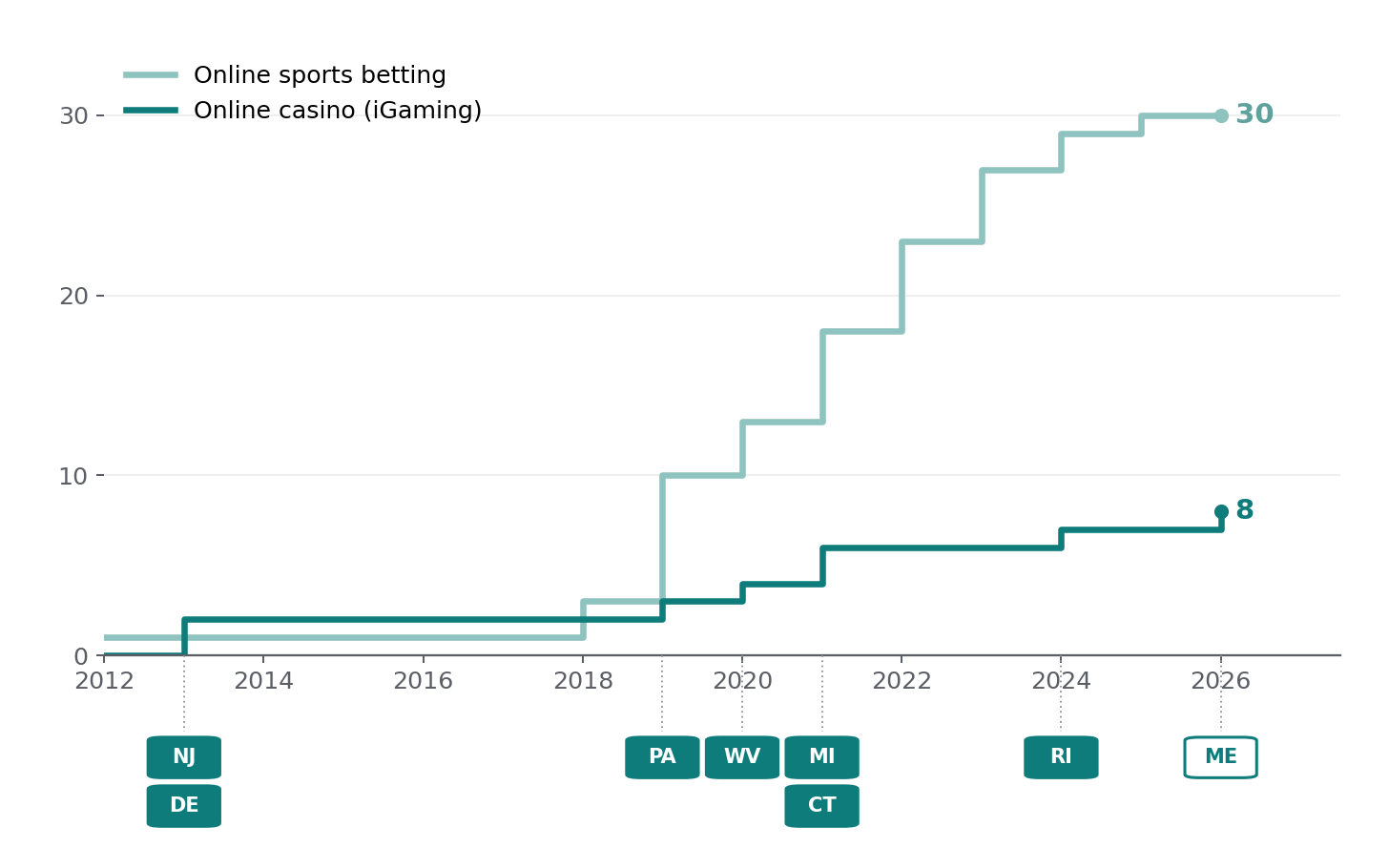
The biggest prize is still locked. The United States is the largest gambling market in the world, and online casino is legal in only about eight states, against roughly thirty for online sports betting.45 As more states regulate, and the long-term direction remains clear, the addressable market expands state by state, on a timeline you can almost watch. Brazil is a preview of what a newly regulated gambling market can look like: its regulated market opened in January 2025 and generated roughly $7bn of GGR in its first year.6
Now hold that against the fear of disruption. Nobody is gambling less, and nobody is migrating away from online. Evolution sits in the segment the rest of the industry is moving into.
Market, check.
Share
Evolution’s share of live casino is enormous: estimates run from roughly 60% to 70% globally. Today’s dominance is not in dispute. The question that decides this lever is whether someone can take that share over the next decade, and the good news is that we don’t have to speculate.
Evolution’s share has been tested from several directions: operators have tried to build an alternative, rivals have tried to compete on games, and pirates have simply tried to steal the product. Each reveals a different part of the moat.
Build. The operators themselves are best placed to try. They own the customers, so why not run their own studio and keep Evolution’s cut? DraftKings did exactly that, and shut its in-house live-dealer studio down in early 20257; Light & Wonder bought its way into live casino in 2021 and discontinued the whole business in February 2025.8 Both walked away for the same reason: scale. Anyone can stream one blackjack table. The hard part is running thousands of them, in dozens of languages, across every time zone, under every market’s compliance regime, and still making money. That only works with a huge player base keeping every table busy around the clock, which is exactly what no single operator has. Live casino violently rewards the largest aggregator, and the largest aggregator, by far, is Evolution. When the companies with the customers, the brand and the budget conclude it’s cheaper to pay Evolution’s toll than to build a road of their own, you learn how deep the moat is.
Compete. The direct rivals, Playtech and Pragmatic Play, do run studios at scale. What they haven’t managed to replicate is the games. Evolution did not stay an invisible supplier of generic blackjack; it built names players hunt for: Crazy Time, Lightning Roulette, Ice Fishing. A player who looks for Crazy Time and doesn’t find it doesn’t shrug and play something else. He leaves, and finds a casino that has it. A rival can copy a wheel. It cannot copy a hit format, a brand, and the player demand behind it. Those were built over years.
And there is one revealing detail about how the biggest rival actually fights. Playtech didn’t try to out-build Evolution on product: it hired Black Cube, an Israeli corporate-intelligence firm, to produce the report that got Evolution’s US licenses investigated, the competitor-commissioned report from the list above. A New Jersey court has since called it “objectively baseless,” and Playtech was publicly unmasked as the party behind it.9 Companies that think they can win on product don’t hire spies.
Steal. Then there’s Asia, where cyber-criminals intercept Evolution’s streams and resell them on illegal sites. Notice what the pirates are not doing: building competing games. They steal Evolution’s, because that is what the players demand. So be precise about what piracy damages. It costs Evolution revenue on players it has already won; it doesn’t move a single player to a competitor. Even if piracy never fully disappears, it caps how much Evolution collects, not who the players belong to. That makes it an enforcement problem, not a share problem.
AI: two different threats
AI is the next threat to watch. It comes in two forms. AI-generated “live” dealers could make the expensive apparatus of real studios and real croupiers obsolete. And AI could flood casino lobbies with cheap new games until a challenger finds the next hit. One threatens the category itself; the other threatens Evolution’s share of it.
I think the first fear is almost exactly backwards, and Todd Haushalter, Evolution’s Chief Product Officer, has a thought experiment that shows why. Someone offers you a bet: five euros on a coin flip. You can flip a real coin in your own hand, or tap a button in a slick app that plays a beautiful animation of a coin landing heads or tails. Same odds. Same five euros. Which do you choose?
The real coin. Every single time. Not because the app is rigged — it isn’t — but because some animal part of your brain refuses to hand money to a process it cannot watch happen. That craving to see the real thing resolve in front of you, live, alongside other real people, is not a detail of live casino. It is the category. And we don’t have to speculate, because the cheap synthetic alternative has existed for decades: every online casino offers instant computer-drawn roulette, with the same odds and a fraction of the cost. Live casino grew into a multi-billion-euro category anyway, sitting right next to it in the same lobby.
The second fear deserves more nuance. AI will make it possible to create far more games, far more cheaply. But more games are not the same thing as more competition. Competition only increases when players actually want to play them.
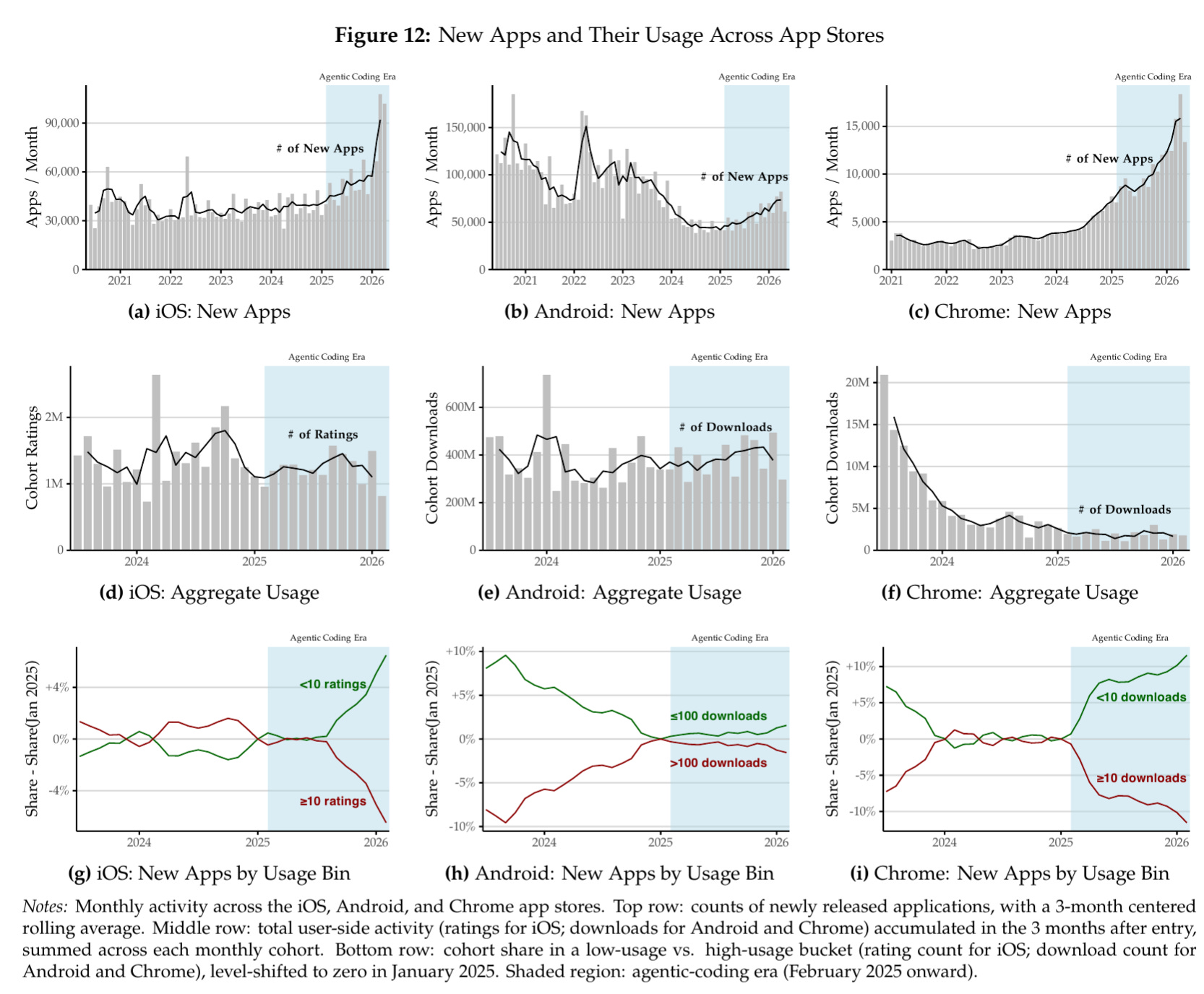
A recent academic study of app stores offers a cleaner preview. As agentic coding tools spread, the number of new apps rose sharply on iOS and Chrome. Usage did not follow in proportion: the share of new apps with almost no ratings or downloads increased from early 2025 onward.10 More software was shipped. Meaningful user attention did not follow.
Evolution itself provides an even cleaner experiment. It has been launching roughly a hundred new titles a year — 113 in 2025 alone — yet only a small minority become franchises capable of moving the business. Ice Fishing is the rare recent example; most releases never become another Crazy Time. The constraint was never the ability to make another playable game. It was making one players want to return to.
AI improves the economics of taking more shots, and that should increase the number of credible attempts. But a thousand cheap prototypes are not a thousand real tests. Engagement can only be discovered by putting a finished game in front of players and earning their attention repeatedly. A startup can make many prototypes; it cannot test an infinite number of finished games against real players without spending capital and time on each one. AI makes experimentation cheaper. It does not make hits automatic.
Now add up the scoreboard. Build failed. Compete failed. Steal costs revenue but moves no players. And AI breaks neither side of live casino’s moat: a synthetic dealer does not reproduce the appeal of watching a real event unfold, while an abundance of playable games does not create an abundance of hits. That is why I believe the share holds: not because nobody attacks it, but because every attack so far has failed to change what players choose.
Share, check.
Price
The third driver is price: what Evolution gets paid for the value it provides. Evolution runs the games, takes no gambling risk, and receives a percentage of the gross gaming revenue (GGR) those games generate for the casino, commonly around 11–12%. Think of it as a toll.
One detail worth getting right: the cut is a percentage of what the casino wins from players, not of what players bet. Evolution never pays out a prize; the operator does. But when a quarter brings a run of giant multiplier wins — Crazy Time can pay up to 25,000x a bet — the casinos win less on those tables, and the base Evolution charges its percentage on shrinks with it. That’s why a lucky quarter for players shows up as a soft quarter for Evolution: not hidden risk, just noise that averages out.
From the casino’s side, stocking Evolution’s games is close to a free roll. A player who wants Crazy Time and cannot find it may simply choose another casino; if he does find it, the operator keeps most of the gaming win and pays Evolution its agreed share. Not carrying a game can cost real revenue even though carrying it adds little risk.
When players ask for your product by name, and the operator pays you only when it generates revenue, you are not the one being squeezed on price.
Management sees no pressure on its pricing, and keeps adding branded inventory nobody else can offer, like the exclusive global deal signed with Hasbro in July 2025 to build live casino around Monopoly.
I’m not going to pretend Evolution is about to raise the toll. It probably won’t, and the thesis doesn’t need it to. The only point that matters for our diagnosis is that there is no structural force pushing Evolution’s pricing down.
Price, check.
Margin
Evolution keeps about two thirds of every euro of revenue as EBITDA — a 66% margin. That is itself proof the moat is real: you don’t get to keep that much in a competitive business. The question is whether it’s sustainable, and the threat I take seriously is regulation forcing production into local markets. A growing number of countries now require live-casino studios physically inside their borders. That breaks the old hub model, where one studio in, say, the Philippines could serve much of the world. Evolution now has to build studios in Brazil, the United States and other markets, each adding fixed costs.
Two forces pull the other way.
First, scale absorbs a lot of it. A local studio is expensive while it is underused. Once built, many of its costs are fixed, and the same game show costs little more to run whether 10,000 or 20,000 people are watching and betting. As a market like Brazil or a large US state grows, utilization rises and the fixed cost spreads across more players. The market’s growth is therefore not only a revenue tailwind; if Evolution’s share holds, it is also a margin offset.
Second, Evolution can increase the output of each studio-hour through software and game design without removing what players came to watch. Ice Fishing is an early example. It is Evolution’s first speed game show. Its main wheel is virtual, so a standard spin takes roughly 20 seconds, compared with about 40 seconds for a Crazy Time spin when no multiplier is involved. But the show is not synthetic: a live host still guides the round and slowly reveals the catch during the bonus game. That distinction matters. The mechanism is automated; the shared human experience is not.
That gives Ice Fishing roughly twice the wheel throughput on standard spins. With the same audience and average bet, that creates roughly twice the wagering capacity from a studio with broadly similar fixed costs. And it isn’t a promise. Ice Fishing has already cleared 23,000 concurrent players, only the second Evolution title ever to do so after Crazy Time, and has recently been overtaking Crazy Time itself in casino scoreboards. It cannibalizes the old flagship a little, but a player moving from a slow game to a fast one, inside the same catalog, at higher monetization per studio-hour, is a trade Evolution makes happily.
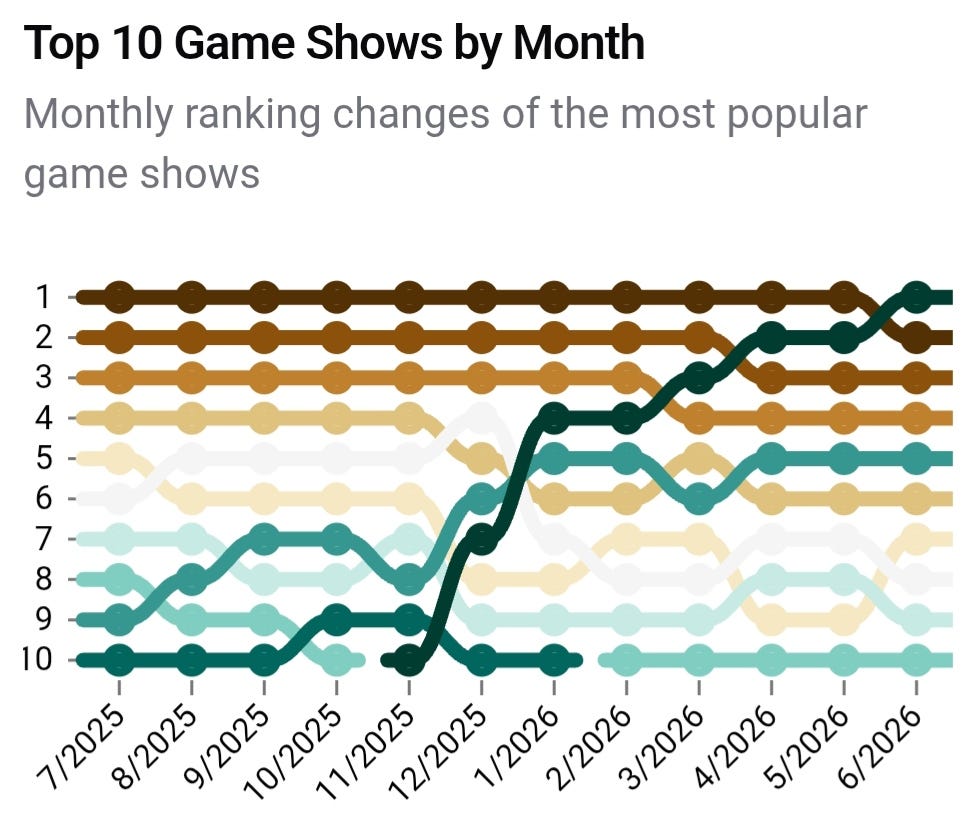
Localization will probably leave the long-run margin below the old 70% peak. But it is not the only structural force at work. A larger audience spreads fixed production costs further, while faster hybrid formats increase revenue per studio-hour. Even at a 50–55% EBITDA margin, Evolution would remain one of the most profitable businesses in the world — and a very unusual one to find at 11x earnings.
Margin, check — with a lower ceiling, but powerful offsets.
The rarest kind of cheap
Great businesses are rarely cheap. Their quality is usually obvious, and the market normally charges for it. When they do reach broken-business multiples, it is rarely because of one decisive blow. More often, several bad news items arrive at once, just as growth or margins begin to soften. Each problem may deserve a valuation haircut. Together, they can make the market turn a weaker period into one bearish narrative about structural decline. The problems share a calendar; they do not necessarily share a cause.
Apple, 2013: roughly 10x forward earnings. Its extraordinary growth had slowed, earnings were falling and margins were under pressure. Investors turned that visible deceleration into a broader story: the product cycle had run out, smartphones were becoming commoditized and Apple had lost its innovative edge after Steve Jobs.
Meta, 2022: roughly 13x forward earnings. Revenue and profits were weakening just as Apple’s privacy changes damaged ad targeting, TikTok competed for attention and spending on the metaverse kept rising. The narrative was no longer simply that advertising was going through a downturn. It was that Meta’s core business was losing its advantage while management was destroying value elsewhere.
Interactive Brokers, 2023: roughly 12x forward earnings. Its earnings had benefited sharply from higher interest rates, and investors feared that future cuts would reverse part of that boost. Softer trading activity reinforced the impression that earnings were near a cyclical peak, even though the underlying franchise remained exceptionally strong.
These were different businesses with different problems, and none is a promise of what happens next at Evolution. But all three were already category leaders with exceptional economics, much like Evolution today. Their quality was visible at the time. The market was not wrong about the facts; it was wrong to treat several temporary pressures as proof that the businesses had structurally changed.
Evolution looks like one of those rare moments. The bad news is real, and without it the opportunity would not exist. But at roughly 11x forward earnings, the price only makes sense if at least one of its four engines is structurally broken. The evidence above points to a weaker period, not a broken model.
Buying, not talking
Management can explain away a weak year. Capital is harder to fake. At Evolution, the CEO, the largest shareholder and the company itself are all doing the same thing: buying shares.
The CEO is buying. Martin Carlesund bought 100,000 Evolution shares in the open market in mid-2025, around SEK 67m — about $7 million — of his own money, more than a year of his total pay. Executives sell for a hundred reasons and buy for only one.
The largest shareholder keeps buying. Kenneth Dart, the reclusive American billionaire, has built a stake of roughly 30% of the company from a standing start, becoming Evolution’s single biggest owner. This is not a tourist.
And the company is buying itself, aggressively. Evolution repurchased €678m of stock in 2024 and another €500m in 2025. What changed in May 2026 is the scale: a €2 billion buyback, the largest in its history, worth roughly a sixth of the entire company at today’s price. And it isn’t sitting in a press release. In its first month alone it retired 1.9% of the company, a pace of roughly 0.5% of all shares outstanding every week. To fund it, management canceled the dividend entirely, an explicit break from its own payout policy, redirecting every available euro into buying back stock at today’s depressed price.
This is what rational capital allocation looks like: keep funding the product, and when the market offers your own shares at a distressed multiple, retire as many as the balance sheet allows. If the core business keeps compounding, every share bought at 11x increases the claim of every share left behind.
The floor, then the upside
I don’t want to build a forecast that pretends to know when Asia recovers or how many US states legalize online casino next year. A better test is to ask what five years might look like if almost nothing goes particularly well:
Revenue grows 6% a year. That is roughly in line with the broader gambling market and well below the expected growth of online casino.
EBITDA margin falls from roughly 66% to 55%. That assumes local studios remain a lasting drag on margins.
The share count shrinks 3% a year. That is slower than the current buyback pace.
Evolution ends the period at 15x earnings. That is a multiple the market routinely pays for mature, low-growth businesses, not for a market leader still growing with a 55% EBITDA margin.
Revenue growing at 6% a year makes the business 1.34x larger after five years. Assuming net earnings move in proportion to EBITDA margin, the fall from 66% to 55% applies a 0.83x factor, leaving earnings at roughly 1.12x today’s level. The buyback adds a further 1.16x earnings-per-share factor. Finally, a move from 11x earnings today to 15x at the end of the period adds a 1.36x valuation factor.
1.34x × 0.83x × 1.16x × 1.36x = 1.8x
If these are the assumptions we are willing to call conservative, the implied floor is roughly 1.8x today’s value in five years, equivalent to a 12% annualized return.
The calculation follows the MOIC framework, where returns come from earnings growth, buybacks and changes in the valuation multiple. More on the calculation here.
In a more normal outcome, revenue grows 10% a year, in line with the expected growth of the live-casino market. EBITDA margin settles at 60% rather than falling to 55%, the share count still shrinks 3% a year, and the market values Evolution at 20x earnings.
That gives approximately 1.61x revenue growth × 0.91x margin factor × 1.16x buyback effect × 1.82x valuation factor = 3.1x today’s value, equivalent to a 25% CAGR over five years.
The upside does not require a return to peak growth or peak margins. It only requires Evolution to grow with its market, retain most of its economics and recover a normal valuation.
Neither case assumes new US state legalizations or any additional upside from markets that are not yet open to Evolution.
Pitfalls
Wider regulatory action following the UK licence review.
New local studios taking longer than expected to fill.
Persistent cybercrime holding back growth in Asia.
New games failing to resonate with players.
Disclaimer: This article is for informational and educational purposes only. Do not interpret anything above as financial advice. Always do your own research before making any investment decision. This is NOT a buy or sell recommendation.